

The Weekly Wealth Watch
July 6, 2026
The Markets
“Successful investing requires discipline, thoughtful diversification, and a long-term perspective. Markets will fluctuate, but resilient portfolios are built to weather those fluctuations.” — Ron O’Hanley, (State Street Global Advisors)
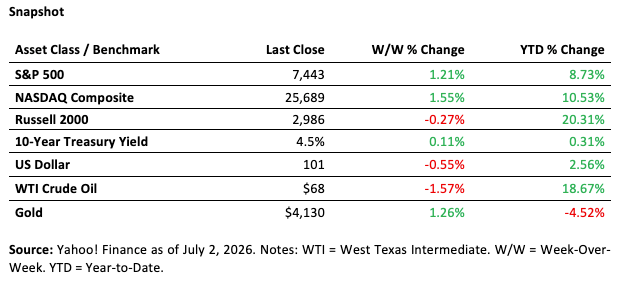
U.S. equity markets continued their upward momentum this holiday-shortened week, supported by resilient economic data and continued investor confidence. The S&P 500 advanced +1.21%, extending its year-to-date gain to +8.73%. Technology shares remained a source of strength, with the NASDAQ Composite rising +1.55%, bringing its year-to-date return to +10.53%. Small-cap stocks were the lone exception, as the Russell 2000 declined –0.27% for the week. Even so, the index continues to lead the major benchmarks in 2026 with an impressive +20.31% year-to-date gain.
In fixed income, the 10-Year Treasury yield increased +0.11%, finishing the week at 4.5%. The modest rise in yields suggests investors continue to monitor economic growth and inflation expectations while balancing the prospect of future Federal Reserve policy decisions.
The U.S. dollar declined –0.55%, though it remains higher by +2.56% year-to-date. A softer dollar can provide support for multinational earnings and certain commodity prices, although its impact was mixed during the week.
Commodity markets were mixed. WTI crude oil declined –1.57%, trimming its year-to-date gain to +18.67%. Oil prices remained sensitive to changing expectations surrounding global demand, supply dynamics, and geopolitical developments. Meanwhile, gold rose +1.26% during the week but remains –4.52% year-to-date. The rebound in gold reflected renewed investor interest in portfolio diversification as markets continue to evaluate the evolving macroeconomic landscape.
Taken together, this week's market action reflected continued resilience beneath the surface. Equities broadly advanced, Treasury yields moved modestly higher, the U.S. dollar softened, and commodity markets consolidated after recent volatility. While short-term market movements are inevitable, the broader picture continues to suggest investors remain focused on economic fundamentals and long-term opportunities rather than reacting to day-to-day headlines.
As Ron O'Hanley reminds us, successful investing is built on discipline, diversification, and maintaining a long-term perspective. This week's market action serves as another reminder that while individual asset classes may move in different directions over short periods, a well-diversified portfolio is designed to navigate changing market environments with resilience and confidence.
Market Memory: Does History Whisper?
"Study the past if you would define the future." — Confucius
Wall Street's favorite disclaimer says, "Past performance does not guarantee future results." Fair enough—but does that mean history tells us nothing?
Not so fast.
Using nearly 100 years of monthly S&P 500 data (1929-2026), we tested whether the previous 12 months of returns contain any information about the next month's return. The answer? Yes—but only a little.
Our statistical model found that past returns explain roughly 3% of future monthly price movements. That's nowhere near enough to predict the market, but it's also far from zero.
Think of it this way: History isn't driving the car... but it may be leaving tire tracks.
Even more interesting, three "memory points" stood out:
- 🚀1 month: Momentum tends to carry over.
- 🪃3 months: Markets often snap back like a rubber band.
- 🌊5 months: A second wave of momentum sometimes appears.
The remaining 97%? That's where earnings, economic growth, monetary policy, innovation—and the occasional geopolitical surprise—take center stage.
Bottom Line
Markets don't have a perfect memory, but they don't suffer from complete amnesia either.
History won't give investors tomorrow's newspaper—but it may offer a few helpful footnotes.
History Rhymes
"The important thing is not to stop questioning." — Albert Einstein
One of the best parts of investing is that there's always another question worth asking.
Sometimes research confirms conventional wisdom. Sometimes it challenges it. This study does a little of both.
Markets remain incredibly efficient, but they're also wonderfully human. People chase trends, overreact, correct mistakes and occasionally repeat them. That's why combining quantitative research with sound fundamental analysis often produces a more complete investment framework than relying on either alone.
As the saying goes, the market may not repeat itself—but it often rhymes.
Human Interest
Ever notice how life has its own version of "market memory?"
The smell of fresh-cut grass can instantly transport you back to childhood. One familiar song can remind you of your first car. Grandma's chocolate-chip cookies still taste exactly like summer vacation.
Our brains are wired to recognize patterns—even if we sometimes see a few that aren't there!
"Memory is the treasury and guardian of all things." — Marcus Tullius Cicero
Fun Facts & Figures
📈 The S&P 500 dataset used in this study spans 1,170 monthly observations, beginning in January 1929.
🧠 The statistical model found that history explains about 3% of future monthly returns—small, but statistically meaningful.
⚾ Baseball players who hit safely in three straight games call it a "streak." Investors call it... a trend!
🎆 Americans consume an estimated 150 million hot dogs on the Fourth of July. Markets may digest earnings better than we digest that many hot dogs.
On This Day in History – July 6
🚴July 6, 1957: John Lennon met Paul McCartney for the first time at a church fête in Liverpool—a chance encounter that would eventually change music history.
"Coming together is a beginning; keeping together is progress; working together is success." — Henry Ford
Sometimes the biggest breakthroughs begin with a single meeting... or a single idea.
Sources & Footnotes:
- WCG autoregressive (AR-12) regression model using monthly S&P 500 data, January 1929-June 2026.
- S&P Dow Jones Indices historical S&P 500 price data.
- Andrew W. Lo & A. Craig MacKinlay, Stock Market Prices Do Not Follow Random Walks (1988).
- Narasimhan Jegadeesh & Sheridan Titman, Returns to Buying Winners and Selling Losers (1993).
- Standard econometric techniques using logged monthly price ratios and autoregressive time-series analysis.
- Historical records documenting the first meeting of John Lennon and Paul McCartney on July 6, 1957.
Disclosures:
- Securities offered through LPL Financial, Member FINRA/SIPC. Investment Advice offered through WCG Wealth Advisors, LLC, a Registered Investment Advisor. WCG Wealth Advisors, LLC is a separate entity from LPL Financial.
- Bond yields are subject to change. Certain call or special redemption features may exist which could impact yield. (118-LPL)
- The S&P 500 is a stock market index tracking the stock performance of 500 of the largest companies listed on stock exchanges in the United States. Indexes are unmanaged and cannot be invested in directly. (102-LPL)
- The NASDAQ Composite Index measures all NASDAQ domestic and non-U.S. based common stocks listed on The NASDAQ Stock Market. The market value, the last sale price multiplied by total shares outstanding, is calculated throughout the trading day, and is related to the total value of the Index. Indexes are unmanaged and cannot be invested in directly. (112-LPL)
- The fast price swings in commodities will result in significant volatility in an investor’s holdings. Commodities include increased risks, such as political, economic, and currency instability, and may not be suitable for all investors. (122-LPL)
- There is no guarantee that a diversified portfolio will enhance overall returns or outperform a non-diversified portfolio. Diversification does not protect against market risk. (26-LPL)
The Russell 2000 Index is generally representative of the 2,000 smallest companies by market capitalization in the Russell 3000 index, which represents approximately 10% of the total market capitalization of the Russell 3000 Index. Indexes are unmanaged and cannot be invested in directly. Bonds are subject to market and interest rate risk if sold prior to maturity. Bond values will decline as interest rates rise. Bonds are subject to availability, change in price, call features and credit risk. The fast price swings in commodities will result in significant volatility in an investor’s holdings. Commodities include increased risks, such as political, economic, and currency instability, and may not be suitable for all investors.
Securities offered through LPL Financial, Member FINRA/SIPC. Investment Advice offered through WCG Wealth Advisors, LLC, a Registered Investment Advisor. WCG Wealth Advisors, LLC is a separate entity from LPL Financial.