

The Weekly Wealth Watch
July 20, 2026
The Markets
“The biggest investment opportunities often emerge when investors can distinguish between short-term market noise and long-term technological change.” — Dan Benton, Founder, Andor Capital Management
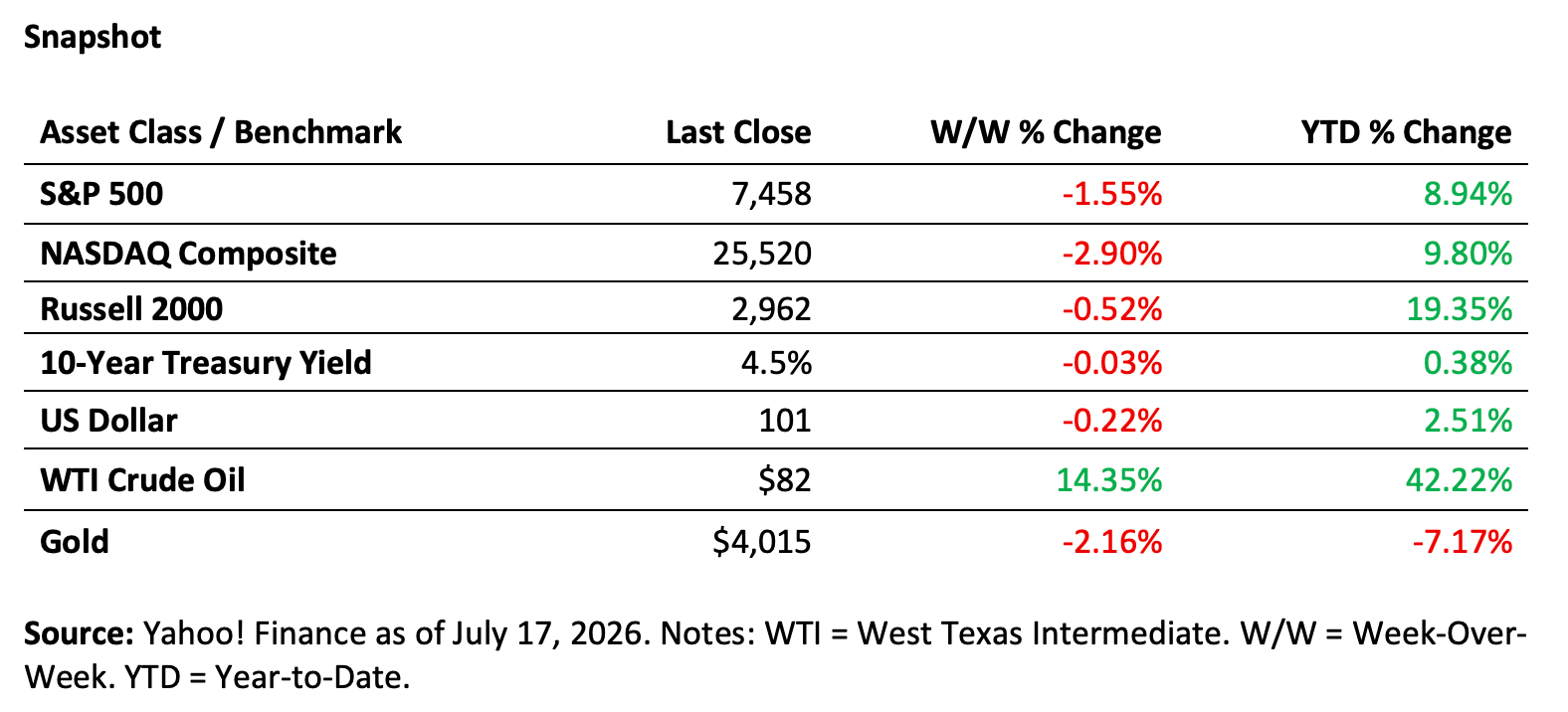
U.S. equity markets paused this week as investors took profits following recent gains and continued to assess corporate earnings, economic data, and evolving policy expectations. The S&P 500 declined –1.55%, though it remains higher by +8.94% year-to-date. Technology shares experienced a steeper pullback, with the NASDAQ Composite falling –2.90%, trimming its year-to-date gain to +9.80%. Small-cap stocks also moved lower, as the Russell 2000 slipped –0.52% for the week. Despite the decline, the index continues to lead the major benchmarks in 2026 with a robust +19.35% year-to-date return.
In fixed income, the 10-Year Treasury yield declined –0.03%, finishing the week at 4.5%. The modest decline in yields suggests investors continue to monitor the outlook for inflation and economic growth while balancing expectations for future Federal Reserve policy.
The U.S. dollar weakened –0.22% during the week but remains +2.51% higher year-to-date. A softer dollar can provide modest support for multinational companies and commodity prices, although broader macroeconomic forces remained the primary driver of market sentiment.
Commodity markets delivered mixed results. WTI crude oil surged +14.35%, lifting its year-to-date gain to +42.22%. The sharp advance reflected renewed concerns surrounding global energy supply, geopolitical developments, and continued volatility in oil markets. In contrast, gold declined –2.16%, extending its year-to-date decline to –7.17%, as investors favored other asset classes despite lingering macroeconomic uncertainty.
Overall, this week's market action reflected a healthy pause following a strong advance earlier in the year. While equities retreated, Treasury yields eased modestly, the U.S. dollar softened, and energy prices moved sharply higher. Periods of consolidation are a normal part of long-term market cycles and often provide investors an opportunity to reassess fundamentals rather than react to short-term price movements.
As Dan Benton reminds us, successful investing requires separating temporary market volatility from long-term structural trends. This week's pullback serves as a reminder that while markets rarely move in a straight line, disciplined investors who remain focused on innovation, earnings growth, and long-term fundamentals are often best positioned to benefit from opportunities that emerge during periods of uncertainty.
Bank Earnings Confirm the "Tech Enablement" Thesis
"Productivity is never an accident. It is always the result of a commitment to excellence, intelligent planning and focused effort." — Paul J. Meyer
Technology isn't just helping technology companies anymore—it's helping everyone.
This earnings season, more S&P 500 companies are raising profit guidance than lowering it, with information technology once again leading the charge. That's exactly what we'd expect if digital tools, artificial intelligence and automation are spreading productivity gains throughout the economy.
Then came the banks.
The nation's biggest financial institutions delivered strong revenue growth—but what really caught investors' attention was how much faster earnings grew than revenues.
Why?
Because banks are becoming technology companies in business suits 😊
Digital platforms, automation and disciplined cost control are allowing firms such as Goldman Sachs, JPMorgan and Citigroup to handle more business without hiring armies of new employees.
In investing, that's called operating leverage. In plain English? Sales go up a little ... profits go up a lot.
Bottom Line
Healthy earnings remain the market's best friend.
Our "Tech Enablement" thesis continues to play out as stronger productivity drives wider profit margins across industries—not just Silicon Valley.
Respect the rally. Don't fear it.
Focus On What Matters
"Success usually comes to those who are too busy to be looking for it." — Henry David Thoreau
It's easy to become distracted by headlines, but earnings season has a funny way of bringing investors back to reality.
Markets can debate politics, interest rates and geopolitics all they want. Eventually, however, companies have to open the books.
So far, those books are telling a pretty encouraging story: Businesses continue finding smarter ways to grow.
Human Interest
Remember when "online banking" felt futuristic?
Today, many of us deposit checks with our phones, pay bills while waiting in line for coffee and ask AI to summarize our emails before lunch.
Technology didn't replace the banker—it simply made banking easier.
The same story is unfolding across medicine, manufacturing, education and countless other industries.
"The advance of technology is based on making it fit in so that you don't really even notice it." — Bill Gates
Fun Facts & Figures
🏦 The largest U.S. banks now process millions of digital transactions every day, many without a single piece of paper changing hands.
💻 Information technology has led S&P 500 companies in positive earnings pre-announcements this quarter.
📈 Operating leverage simply means profits can grow faster than revenues when companies keep expenses under control.
☕ The average cup of coffee contains about 95 milligrams of caffeine—roughly enough to read one earnings report ... or three if it's a Monday morning 😊
On This Day in History – July 20
🌕July 20, 1969: Neil Armstrong became the first person to walk on the Moon, declaring,
"That's one small step for [a] man, one giant leap for mankind."
More than half a century later, it remains one of humanity's greatest demonstrations of what vision, innovation and teamwork can accomplish.
Sources & Footnotes:
- FactSet, S&P 500 Earnings Insight and EPS pre-announcement data, July 2026.
- Seeking Alpha, 2Q26 earnings reports for Goldman Sachs, JPMorgan Chase and Citigroup.
- WCG analysis of operating leverage, earnings revisions and the "Tech Enablement" investment thesis.
- Company quarterly earnings releases and investor presentations.
- NASA historical archives documenting the Apollo 11 Moon landing on July 20, 1969.
- Peter Drucker and Bill Gates quotations from published works and interviews.
Disclosures:
Securities offered through LPL Financial, Member FINRA/SIPC. Investment Advice offered through WCG Wealth Advisors, LLC, a Registered Investment Advisor. WCG Wealth Advisors, LLC is a separate entity from LPL Financial.
Bond yields are subject to change. Certain call or special redemption features may exist which could impact yield. (118-LPL)
The S&P 500 is a stock market index tracking the stock performance of 500 of the largest companies listed on stock exchanges in the United States. Indexes are unmanaged and cannot be invested in directly. (102-LPL)
The NASDAQ Composite Index measures all NASDAQ domestic and non-U.S. based common stocks listed on The NASDAQ Stock Market. The market value, the last sale price multiplied by total shares outstanding, is calculated throughout the trading day, and is related to the total value of the Index. Indexes are unmanaged and cannot be invested in directly. (112-LPL)
The fast price swings in commodities will result in significant volatility in an investor’s holdings. Commodities include increased risks, such as political, economic, and currency instability, and may not be suitable for all investors. (122-LPL)
There is no guarantee that a diversified portfolio will enhance overall returns or outperform a non-diversified portfolio. Diversification does not protect against market risk. (26-LPL)
The Russell 2000 Index is generally representative of the 2,000 smallest companies by market capitalization in the Russell 3000 index, which represents approximately 10% of the total market capitalization of the Russell 3000 Index. Indexes are unmanaged and cannot be invested in directly. Bonds are subject to market and interest rate risk if sold prior to maturity. Bond values will decline as interest rates rise. Bonds are subject to availability, change in price, call features and credit risk. The fast price swings in commodities will result in significant volatility in an investor’s holdings. Commodities include increased risks, such as political, economic, and currency instability, and may not be suitable for all investors.
Securities offered through LPL Financial, Member FINRA/SIPC. Investment Advice offered through WCG Wealth Advisors, LLC, a Registered Investment Advisor. WCG Wealth Advisors, LLC is a separate entity from LPL Financial.