

The Markets
“What matters more is having a bold vision and pursuing it with unwavering conviction.” — Masayoshi Son, Chairman & CEO, SoftBank Group Corp.
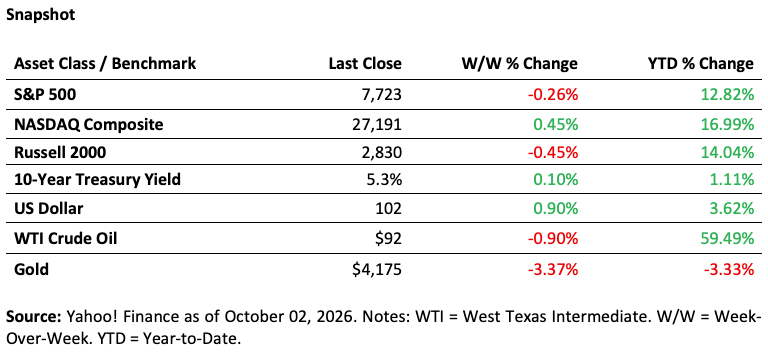
U.S. equity markets finished the week mixed. The S&P 500 declined –0.26%, bringing its year-to-date gain to +12.82%. The NASDAQ Composite advanced +0.45%, extending its year-to-date return to +16.99%. Small-cap stocks also moved lower, with the Russell 2000 declining –0.45%, though it remains up +14.04% year-to-date.
In fixed income, the 10-Year Treasury yield increased +0.10%, finishing the week at 5.3%. The benchmark yield is now up +1.11% year-to-date, keeping interest rates an important consideration across both equity and fixed-income markets.
The U.S. dollar strengthened +0.90% during the week, bringing its year-to-date gain to +3.62%.
Commodities moved lower. WTI crude oil declined –0.90%, finishing the week at $92 per barrel, although it remains up a substantial +59.49% year-to-date.
Gold fell –3.37%, finishing at $4,175, bringing its year-to-date return to –3.33%.
Overall, the first week of October presented another mixed picture across markets. Technology shares continued to show relative strength, while the broader S&P 500 and small-cap Russell 2000 moved modestly lower. At the same time, Treasury yields and the U.S. dollar moved higher, while both oil and gold declined. Despite the week's crosscurrents, all three major equity benchmarks remain firmly positive for the year.
Masayoshi Son's investment philosophy provides a fitting perspective for a market increasingly shaped by technological change. Son founded SoftBank and later established the SoftBank Vision Fund, designed to invest globally in technology companies. His focus has increasingly centered on AI; in SoftBank's 2026 report, Son argued that the AI revolution is still in its early stages while acknowledging that others see bubble-like conditions. For investors, the broader lesson is not that every technology investment will succeed, but that periods of rapid innovation can create both opportunity and uncertainty—making discipline, diversification, and a long-term perspective especially important.
Yielding to Growth: Why Stocks Have Room to Run
Bond yields are rising. Investors are nervous. And yet the S&P 500 is still less than 2% below its all-time closing high.
So what gives?
The important distinction is why yields are rising. If bond yields are climbing because the economy is deteriorating, that's bad news. If they're rising because economic growth is resilient, that's a different story.
Right now, the evidence points more toward growth than distress.
As Benjamin Graham famously wrote in The Intelligent Investor: **“The investor’s chief problem—and even his worst enemy—is likely to be himself.”**¹ Translation: sometimes the hardest thing to manage isn't the market. It's our reaction to the market.
📈 The Bond Market: Growth Is Driving the Bus
The 10-year Treasury yield has risen this year, but the underlying ingredients matter.
- Real yields: up more than 50% YTD and now represent more than 55% of the 10-year yield.
- Term premium: up nearly 79% YTD.
- Breakeven inflation: barely changed.
That last point is important. If inflation expectations were exploding, we'd have a different conversation.
Instead, much of the move appears tied to economic resilience.
Think of it this way: higher rates caused by a stronger economy are more like the car going uphill than the engine falling apart.
As Dwight Eisenhower put it: **“Plans are useless, but planning is indispensable.”**² Markets rarely follow the script—but understanding what's driving them still matters.
🧮 Stocks vs. Rates: Don't Forget the Carry
Here's the fun part.
Since 1980, S&P 500 returns averaged:
- 10.1% when nominal GDP growth exceeded the 10-year Treasury yield.
- 5.6% when it didn't.
That's a 4.5-percentage-point difference.
And today? Nominal GDP growth is roughly 2 percentage points above the 10-year Treasury yield.
In other words, the economy is still producing more nominal growth than the bond market is demanding.
The yield curve tells a similar story. The 10-year Treasury yield is about 0.4 percentage points above the 2-year yield, meaning the curve is normally sloped rather than inverted.
No, this doesn't mean stocks have a guaranteed VIP pass to higher prices. But it does suggest that higher yields aren't automatically a death sentence for equities.
👨👩👧👦 Human Interest: The Family Budget Meets the Bond Market
Here's a simple way to think about it.
Imagine your family business is growing sales, customers are spending and profits are rising. Your bank says, “Because things are going well, I'm going to charge you a little more to borrow.”
Annoying? Absolutely.
A sign of economic collapse? Not necessarily.
That's essentially the distinction we're seeing in the bond market.
And it helps explain why investors shouldn't automatically equate higher yields = lower stocks.
Benjamin Graham's warning about investors being their own worst enemy feels particularly appropriate here. The headlines scream “Rates!” while the underlying economy is quietly saying “Yeah, but I'm still growing.”
🤓 Fun Facts & Figures
A few numbers worth sticking on the refrigerator:
- Under 2%: How far the S&P 500 is from its all-time closing high.
- +79%: YTD increase in the 10-year Treasury's term premium.
- +50%+: YTD increase in real yields.
- 55%+: Share of today's 10-year yield represented by real yields.
- 10.1%: Average S&P 500 return in positive GDP-vs.-10-year-yield regimes since 1980.
- 5.6%: Average return in negative regimes.
- 4.5 ppts: The historical performance gap.
- 0.4 ppts: Current 10Y-minus-2Y Treasury spread.
- September: Historically the weakest month for U.S. stocks.
- October: Historically… well, let's just say the stock market has occasionally enjoyed a little Halloween drama. 🎃
As Robert Browning wrote in Rabbi Ben Ezra: **“The best is yet to be.”**³ That's a pretty good motto for entering the fourth quarter.
📅 On This Day in History — October 5
1962: James Bond made his big-screen debut in Dr. No, with Sean Connery introducing the world to 007. On the very same day, the Beatles released “Love Me Do” in the U.K. Talk about a market with momentum.⁴
1947: President Harry Truman delivered the first televised presidential address from the White House, asking Americans to conserve food to help postwar Europe.⁵
2011: Apple co-founder Steve Jobs died at age 56. His legacy is a reminder that transformative ideas can have effects far beyond their original moment.⁶
And October 5 happens to be the birthday of astrophysicist Neil deGrasse Tyson, who turns 68 in 2026.⁷
A fitting thought from Tyson: **“The good thing about science is that it's true whether or not you believe in it.”**⁸ Markets aren't quite that cooperative—but the economic data still deserve a hearing.
🏁 Bottom Line
Don't confuse higher yields with economic trouble.
The bond market is demanding more yield, but much of that adjustment appears to reflect economic resilience rather than an inflationary blowout. Meanwhile, GDP growth remains comfortably above the 10-year Treasury yield, the yield curve is normally sloped, and historical equity returns have been stronger in similar environments.
September may have been sluggish.
But as we head into the seasonally stronger fourth quarter, the growth and earnings engines still have plenty of runway.
Or, as Browning put it: the best is yet to be.
Sources & Footnotes:
- Benjamin Graham, The Intelligent Investor (1949; revised editions). The quotation appears in Graham's discussion of investor temperament and behavior.
- Dwight D. Eisenhower, quotation from his remarks about military planning: “In preparing for battle I have always found that plans are useless, but planning is indispensable.”
- Robert Browning, “Rabbi Ben Ezra,” Dramatis Personae (1864). The poem begins, “Grow old along with me! / The best is yet to be.”
- October 5, 1962:Dr. No premiered in Britain, marking James Bond's film debut; the Beatles' “Love Me Do” was also released in the U.K.
- October 5, 1947: Harry Truman delivered the first televised presidential address from the White House, calling for food conservation to aid postwar Europe.
- October 5, 2011: Steve Jobs died at age 56.
- Neil deGrasse Tyson, born October 5, 1958.
- Neil deGrasse Tyson, widely published quotation on the distinction between scientific truth and belief.
WCG source data: FRED and WCG calculations, as supplied, 9/30/26. All market statistics, historical return comparisons, yield decompositions and forward-looking interpretations above are based on the source material provided.
Disclosures:
- Securities offered through LPL Financial, Member FINRA/SIPC. Investment Advice offered through WCG Wealth Advisors, LLC, a Registered Investment Advisor. WCG Wealth Advisors, LLC is a separate entity from LPL Financial.
- Bond yields are subject to change. Certain call or special redemption features may exist which could impact yield. (118-LPL)
- The S&P 500 is a stock market index tracking the stock performance of 500 of the largest companies listed on stock exchanges in the United States. Indexes are unmanaged and cannot be invested in directly. (102-LPL)
- The NASDAQ Composite Index measures all NASDAQ domestic and non-U.S. based common stocks listed on The NASDAQ Stock Market. The market value, the last sale price multiplied by total shares outstanding, is calculated throughout the trading day, and is related to the total value of the Index. Indexes are unmanaged and cannot be invested in directly. (112-LPL)
- The fast price swings in commodities will result in significant volatility in an investor’s holdings. Commodities include increased risks, such as political, economic, and currency instability, and may not be suitable for all investors. (122-LPL)
- There is no guarantee that a diversified portfolio will enhance overall returns or outperform a non-diversified portfolio. Diversification does not protect against market risk. (26-LPL)
The Russell 2000 Index is generally representative of the 2,000 smallest companies by market capitalization in the Russell 3000 index, which represents approximately 10% of the total market capitalization of the Russell 3000 Index. Indexes are unmanaged and cannot be invested in directly. Bonds are subject to market and interest rate risk if sold prior to maturity. Bond values will decline as interest rates rise. Bonds are subject to availability, change in price, call features and credit risk. The fast price swings in commodities will result in significant volatility in an investor’s holdings. Commodities include increased risks, such as political, economic, and currency instability, and may not be suitable for all investors.
Securities offered through LPL Financial, Member FINRA/SIPC. Investment Advice offered through WCG Wealth Advisors, LLC, a Registered Investment Advisor. WCG Wealth Advisors, LLC is a separate entity from LPL Financial.
1186717-100526